ARCHIVES (2015)
Do roku 2016 raport oznaczony numerem 1 był tworzony za okres od 1 kwietnia do 31 maja. Od roku 2017 analizy są wykonywane o dekadę wcześniej czyli 1 raport oznacza okres od 21 marca do 20 maja
Communication report regarding the incidences of drought conditions in Poland
Year: 2015; period: 12 (21.VII - 20.IX)
The Institute of Soil Science and Plant Cultivation - State Research Institute in accordance with an Act from the Minister of Agriculture and Rural Development has developed the climatic water balance for all Polish municipalities (3,064 municipalities), and based on the soils categories have identified in those municipalities the current agricultural drought risk for the following crops: rape, turnip rape and sugar beet.
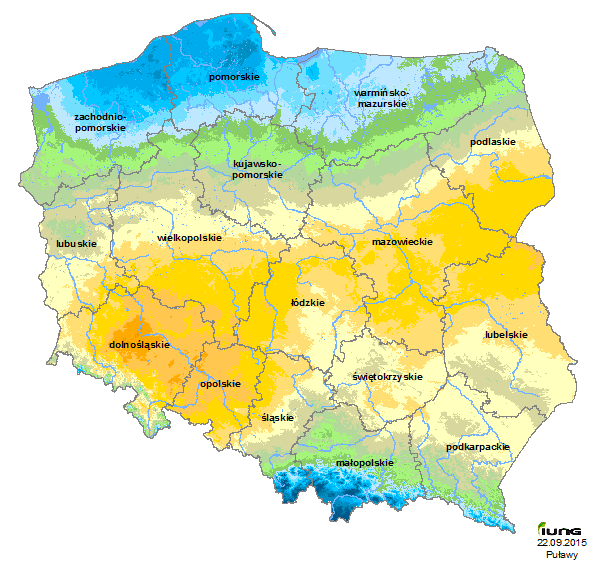
In the twelfth reporting period, i.e. from July 21 to September 20, 2015, does state a risk of agricultural drought in Poland. The values of climatic water balance (CWB), which are the basis to assess the risk of drought, are negative.
In the current sixty days period threat to agricultural drought occurs among crops:
- Rape and turnip rape
- Sugar beet
The value of CWB on Polish territory compared to the previous reporting period had increased by 7 mm on average for the country. However, in the north-eastern and western Polish regions had a decrease in the value of approx. 10 mm.
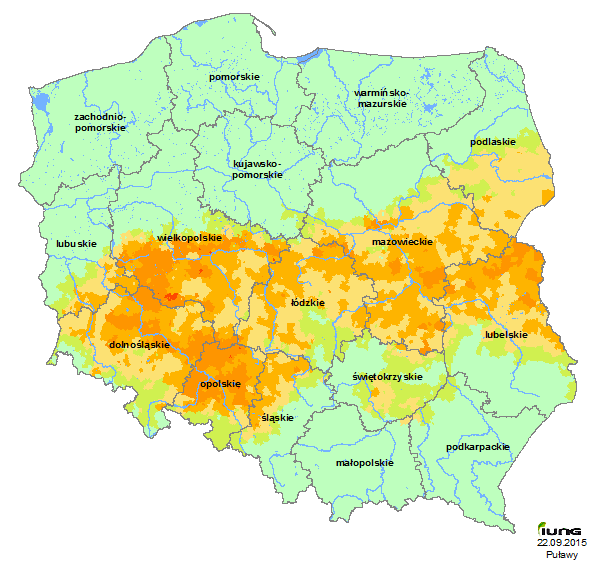
Currently the biggest threat of drought in Poland still occurs for rape and turnip rape grown in soils of II category and for sugar beet grown in soils of II and III.
Drought for rape and turnip rape occurs in 13 voivodeships of the country, in 1407 local districts (45.6 % of local districts) on 11.7% of arable land.
The highest risk of drought (in over 96% of local districts) have been reported in the Opolskie and Lodzkie voivodeship.
Very high risk of drought also occurs in four voivodeships: Dolnośląskie, Mazowieckie, Wielkopolskie and Lubelskie (more than 63% of local district).
To regions with a high risk of drought among these crops may include the Podlaskie, Świętokrzyskie, Śląskie and Lubuskie voivodeships (over 37% of local districts).
Detailed data on this crop are presented in Table 1.
Table 1. Risk of agricultural drought for rape and turnip rape crops
|
No. |
Voivodeship |
Number of local districts |
Number of local districts at risk |
The share of local districts under risk [%] |
The share of arable land under risk [%] |
|
1 |
opolskie |
103 |
102 |
99.0 |
21.7 |
|
2 |
łódzkie |
202 |
194 |
96.0 |
24.3 |
|
3 |
dolnośląskie |
224 |
197 |
87.9 |
17.1 |
|
4 |
mazowieckie |
364 |
279 |
76.6 |
21.7 |
|
5 |
wielkopolskie |
316 |
211 |
66.8 |
24.8 |
|
6 |
lubelskie |
234 |
148 |
63.2 |
16.2 |
|
7 |
podlaskie |
141 |
74 |
52.5 |
8.6 |
|
8 |
świętokrzyskie |
128 |
66 |
51.6 |
4.0 |
|
9 |
śląskie |
189 |
77 |
40.7 |
12.6 |
|
10 |
lubuskie |
116 |
43 |
37.1 |
7.9 |
|
11 |
podkarpackie |
189 |
12 |
6.3 |
0.4 |
|
12 |
kujawsko-pomorskie |
179 |
3 |
1.7 |
0.03 |
|
13 |
małopolskie |
225 |
1 |
0.4 |
0.1 |
|
|
Polska |
3064 |
1407 |
45.9 |
11.7 |
Drought for sugar beet occurs in 13 voivodeships of the country, in 1409 local districts (46 % of local districts) on 13.2% of arable land.
The highest risk of drought (in over 96% of local districts) have been reported in the Opolskie and Lodzkie voivodeship.
Very high risk of drought also occurs in four voivodeships: Dolnośląskie, Mazowieckie, Wielkopolskie and Lubelskie (more than 63% of local district).
To regions with a high risk of drought among these crops may include the Podlaskie, Świętokrzyskie, Śląskie and Lubuskie voivodeships (over 37% of local districts).
Detailed data on this crop are presented in Table 2.
Table 2. The threat of agricultural drought for potato cultivation.
|
No. |
Voivodeship |
Number of local districts |
Number of local districts at risk |
The share of local districts under risk [%] |
The share of arable land under risk [%] |
|
1 |
opolskie |
103 |
102 |
99.0 |
38.0 |
|
2 |
łódzkie |
202 |
194 |
96.0 |
24.7 |
|
3 |
dolnośląskie |
224 |
199 |
88.8 |
31.1 |
|
4 |
mazowieckie |
364 |
279 |
76.6 |
21.7 |
|
5 |
wielkopolskie |
316 |
211 |
66.8 |
25.6 |
|
6 |
lubelskie |
234 |
148 |
63.2 |
16.5 |
|
7 |
podlaskie |
141 |
74 |
52.5 |
8.6 |
|
8 |
świętokrzyskie |
128 |
66 |
51.6 |
4.0 |
|
9 |
śląskie |
189 |
77 |
40.7 |
12.6 |
|
10 |
lubuskie |
116 |
43 |
37.1 |
7.9 |
|
11 |
podkarpackie |
189 |
12 |
6.3 |
0.4 |
|
12 |
kujawsko-pomorskie |
179 |
3 |
1.7 |
0.03 |
|
13 |
małopolskie |
225 |
1 |
0.4 |
0.1 |
|
|
Polska |
3064 |
1409 |
46.0 |
13.2 |
Still an area particularly vulnerable to water deficit is in Dolnośląskie and Opolskie voivodeship. Within these voivodeships the shortage of water for crops as compared to the prior sixty days period increased by 10 mm and currently ranges from -210 to -219 mm.
As in the previous reporting period (in the seventh, eighth, ninth, tenth and eleventh reporting period) as in the twelfth, an area particularly vulnerable to water deficit is still Lublin region (-180 up to -199 mm). On outwith those territories similar water scarcity was recorded in Mazowieckie, Łódzkie and Wielkopolskie.
It should also be noted that there has been an increase in water scarcity in the southern voivodeships: Podlaskie and Mazowieckie in those territories water deficit increased by 10 mm.
Yield reduction of 20% at local district scale in a given year as compared to yields obtained during multiannual averages of weather conditions, found so far the threat of drought during the growing season in 2015 on Polish territory among 14 groups and plant species:
- Spring cereals
- Winter cereals
- Shrubs
- Strawberries
- Legumes
- Rape and turnip rape
- Tobacco
- Ground vegetables
- Potato
- Hops
- Silage maize
- Grain maize
- Sugar beet
- Fruit trees
The total number of local districts threatened by drought this year in Poland and the participation of local district at risk (in%) is presented in table 3.
Table 3. Total number of local districts threatened by drought this year in Poland (%)
|
Lp. |
Cultivar |
Number of local districts at drought risk |
The share of number of local districts at drought risk in Poland [w %] |
|
1 |
Legumes |
3037 |
99.1 |
|
2 |
Potato |
3019 |
98.5 |
|
3 |
Fruit shrubs |
3019 |
98.5 |
|
4 |
Hops |
2549 |
83.2 |
|
5 |
Tobacco |
2323 |
75.8 |
|
6 |
Ground vegetables |
2285 |
74.6 |
|
7 |
Spring cereals |
2278 |
74.3 |
|
8 |
Silage maize |
1849 |
60.3 |
|
9 |
Fruit trees |
1828 |
59.7 |
|
10 |
Sugar beet |
1014 |
33.1 |
|
11 |
Strawberries |
763 |
24.9 |
|
12 |
Winter cereals |
546 |
17.8 |
|
13 |
Grain maize |
521 |
17.0 |
|
14 |
Rape and turnip rape (2014/2015) |
111 |
3.6 |
|
14a |
Rape and turnip rape (2015/2016) |
1409 |
45.9 |
A potential area under agricultural drought risk in 2015 in Poland are presented in Table 4.
Table 12. The potential area under agricultural drought risk in 2015
|
Lp. |
Cultivar |
The area of drought risk [%] |
|
1 |
Legumes |
79.0 |
|
2 |
Potato |
79.0 |
|
3 |
Fruit shrubs |
75.1 |
|
4 |
Hops |
37.1 |
|
5 |
Tobacco |
36.3 |
|
6 |
Ground vegetables |
29.5 |
|
7 |
Spring cereals |
22.5 |
|
8 |
Silage maize |
17.5 |
|
9 |
Fruit trees |
16.7 |
|
10 |
Sugar beet |
10.7 |
|
11 |
Strawberries |
5.5 |
|
12 |
Winter cereals |
5.2 |
|
13 |
Grain maize |
4.2 |
|
14 |
Rape and turnip rape (2015/2016) |
0.8 |
|
14a |
Rape and turnip rape (2015/2016)| |
13.2 |
In July, there have been very similar distribution of air temperature on Polish territory as in June. The lowest air temperature was recorded in the northern and north - eastern parts of the country. In contrast, the highest temperature was recorded in the south-western areas. In the northern regions of the country was recorded a temperature even below 17.0 degrees. In the southern areas of the Pomorskie Lakeland, Mazurskie Lakeland, Podlaska Lowland it was also chilly with temperatures ranging from 17°C to 18 °C. At the Highlands and Lowlands of Poland recorded a high temperature of 18°C to 20°C. In contrast, the highest temperature (above 20°C) was recorded in southern areas of the Śląska Lowland and the Karpaty Foothills, in some parts of the area were recorded even above 21°C.
The temperature distribution in August did not deviate from its distribution in June and July. Coldest, still was on the Embankment with temperature below 20°C. In the southern regions of Pomorskie Lake District, the area of the Mazurskie Lake District were recorded from 20 to 21°C. Warmest, more than 23°C, it was the Śląskie Lowland. In the rest of the country was recorded from 21 to 23°C. This year's August was very warm. In the north air temperature was higher than the long-term average by 2 to 4°C. In the rest of country recorded temperature higher than the long-term by 4 to 5°C and sometimes even higher by more than 5°C.
In the first ten days of September it recorded a relatively high temperature reduction to below 14°C, at the Pomorskie Lake District and Podlasie. In the rest of Poland also it was cool from 14 to 16°C, only the Opole region of Dolny Śląsk recorded temperatures exceeding 16°C. The second ten days of this month was warmer. In the north of the country recorded a temperature of 15.5 to 16.5°C, the farther south of the country that was warmer, in centre of country from 16.5 to 17.5°C in the Sandomierz Basin and especially in Podkarpacie reported from 18 to more than 18.5°C.
In July precipitation occurred in five main stripes, three of which were characterized by a relatively high rainfall from 70 to 100 mm, and two of them precipitation smaller - amounting to as low as less than 30 to 70 mm. Higher rainfall (above 70 mm) occurred on the Baltic coast, in northern regions of the Pomorskie Lake District, on Ziemia Lubuska, Wielkopolskie and Mazurskie Lakeland and south-eastern Poland. In contrast, areas with less rainfall (less than 70 mm) were in the southern regions of the Pomorskie Lake District, and Plains: Wielkopolska, Śląska, Mazowiecka, Podlaska and Wyżyny Polskie.
This year in August was extremely dry. The lowest rainfall of less than 10 mm were recorded in Kujawy, Żuławy, Izerskie Foothills, Dolnośląskie Bory, Mazowiecka Lowland, the Lublin Upland and Polesie. A substantial area of the country also was recorded with low rainfall of 10 to 30 mm, only in the area of Kalisz Upland, Leszno Upland Krakow-Czestochowa Upland and in the western part of the Małopolska Highland recorded rainfall greater than 30 to more than 60 mm. In Kujawy, eastern areas Lublin region, southern regions of Śląskie and Mazowsze Lowland rainfall amounted to 10% of normal long-term norm. On the majority of the country rainfall ranged from 10 to 30% of normal long-term norm. Only in the area of Kalisz Upland, Leszno and Krakow-Czestochowa Upland rainfall was slightly higher, from 70 to 100% of norm.
The first ten days of September was characterised with a very diverse precipitation. High rainfall occurred in Kaszuby and in the western part of the Pomorskie Lake District from 50 to 90 mm and sometimes even more than 90 mm. The lowest rainfall recorded in Wielkopolska, in the southern part of the Śląska Lowland, Podlasie, Małopolska Highland, Sandomierz Basin and the Karpackie Foothills from 10 to 20 mm.
In the second ten days of September also marked by a very diverse precipitation. The high rainfall, as in the first ten days of this month, occurred in the western part of the Pomorskie Lake District, more precipitation was recorded also in the north-eastern part of the country and a large territory south-eastern Poland, from 20 to more than 50 mm. The lowest rainfall less than 10 mm were recorded in Wielkopolska, and in the southern part of the Śląska Lowland and Podlasie.
Reports
- Report 13 (1.VIII - 30.IX) +
- Report 12 (21.VII - 20.IX) +
- Report 11 (11.VII - 10.IX) +
- Report 10 (1.VII - 31.VIII) +
- Report 09 (21.VI - 20.VIII) +
- Report 08 (11.VI - 10.VIII) +
- Report 07 (1.VI - 31.VII)
- Report 06 (21.V - 20.VII)
- Report 05 (11.V - 10.VII) +
- Report 04 (1.V - 30.VI) +
- Report 03 (21.IV - 20.VI) +
- Report 02 (11.IV - 10.VI) +
- Report 01 (1.IV - 31.V)