ARCHIVES (2015)
Do roku 2016 raport oznaczony numerem 1 był tworzony za okres od 1 kwietnia do 31 maja. Od roku 2017 analizy są wykonywane o dekadę wcześniej czyli 1 raport oznacza okres od 21 marca do 20 maja
Communication report regarding the incidences of drought conditions in Poland
Year: 2015; period: 02 (11.IV - 10.VI)
The Institute of Soil Science and Plant Cultivation - State Research Institute in accordance with an Act from the Minister of Agriculture and Rural Development has developed the climatic water balance for all Polish municipalities (3,064 municipalities), and based on the soils categories have identified in those municipalities the current agricultural drought risk for the following crops: winter and spring cereals, oilseed rape and turnip rape, sugar beet, shrubs and fruit trees and strawberries.
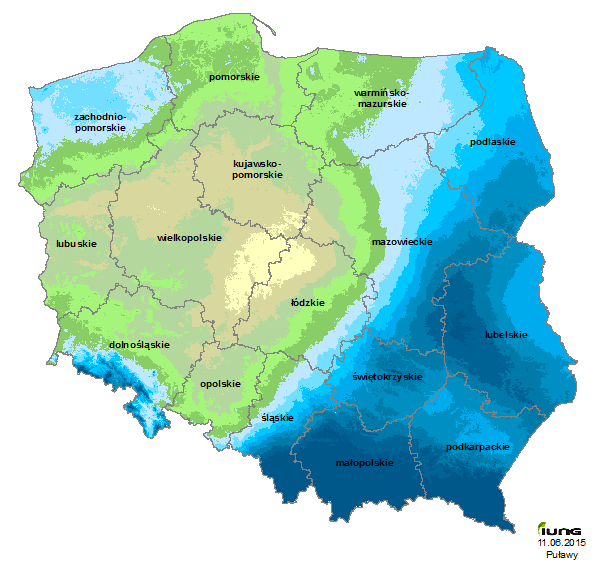
In the second reporting period, i.e. from April 11 to June 10, 2015, IUNG-PIB state a risk of agricultural drought in Poland. The values of climatic water balance (CWB), which are the basis to assess the risk of drought, are negative over the entire range Poland.
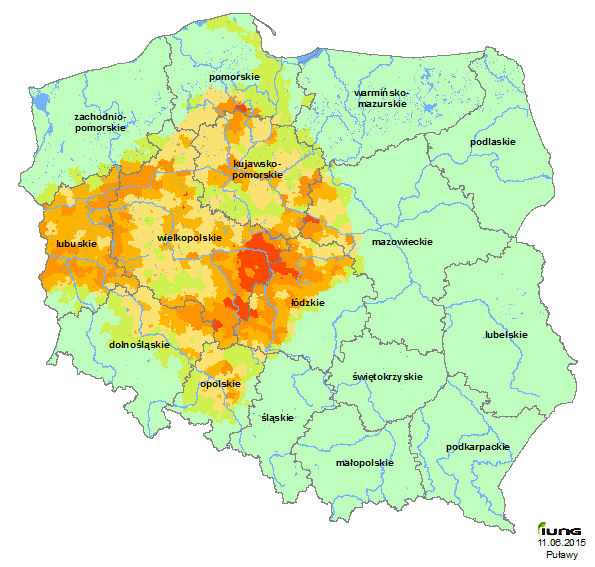
The threat of drought is present on the surface of 9.5% of arable land in 971 local districts (31.7% of Polish local districts), gathered in 11 voivodeships:
- wielkopolskim
- kujawsko-pomorskim
- łódzkim
- lubuskim
- dolnośląskim
- opolskim
- pomorskim
- mazowieckim
- zachodniopomorskim
- warmińsko-mazurskim
- śląskim
The greatest risk of drought is present for fruit shrubs.
I category (very light soil, granulometric group: sand
II category (light soil, granulometric group: loamy sand)
Table 1 contains detailed data on the number of local districts and % of local districts and area of arable land for Voivodeships where there is drought risk for the cultivation of fruit shrubs.
|
No. |
Voivodeship |
Number of local districts at risk |
The share of local district at draught risk [%] |
The share of area at draught risk [%] |
|
1 |
wielkopolskie |
311 |
98.4 |
35.7 |
|
2 |
kujawsko-pomorskie |
173 |
96.4 |
18.9 |
|
3 |
pomorskie |
40 |
28.6 |
2.2 |
|
4 |
łódzkie |
124 |
61.4 |
26.8 |
|
5 |
lubuskie |
102 |
87.9 |
34.4 |
|
6 |
dolnośląskie |
81 |
36.2 |
8.9 |
|
7 |
opolskie |
64 |
62.1 |
7.2 |
|
8 |
pomorskie |
57 |
40.7 |
3.1 |
|
9 |
mazowieckie |
46 |
12.6 |
3.8 |
|
10 |
zachodniopomorskie |
10 |
6.1 |
0.5 |
|
11 |
warmińsko-mazurskie |
2 |
1.3 |
0.0 |
|
12 |
śląskie |
1 |
0.5 |
0.0 |
Slightly lower risk of drought occur among spring cereals. Drought for these crops occurs in the period under consideration of sixty days period on soils category I and II. It is present in 522 local districts (17% of local districts in the country) on 5.2% of the arable land. The data on these crops is shown in Table 2.
|
No. |
Voivodeship |
Number of local districts at risk |
The share of local district at draught risk [%] |
The share of area at draught risk [%] |
|
1 |
wielkopolskie |
213 |
67.4 |
24.5 |
|
2 |
kujawsko-pomorskie |
132 |
73.7 |
11.5 |
|
3 |
łódzkie |
86 |
42.6 |
17.9 |
|
4 |
lubuskie |
42 |
36.2 |
5.7 |
|
5 |
dolnośląskie |
21 |
9.4 |
1.9 |
|
6 |
mazowieckie |
16 |
4.4 |
1.5 |
|
7 |
opolskie |
12 |
11.7 |
0.8 |
Similar threat of drought was recorded for strawberries. For this crop, drought occurred on soils category I and II, in 522 local districts (17% of local districts in the country) on 5.2% of the arable land. Data of drought risk for the crop are presented in Table 3.
|
No. |
Voivodeship |
Number of local districts at risk |
The share of local district at draught risk [%] |
The share of area at draught risk [%] |
|
1 |
wielkopolskie |
213 |
67.4 |
24.5 |
|
2 |
kujawsko-pomorskie |
132 |
73.7 |
11.5 |
|
3 |
łódzkie |
86 |
42.6 |
17.9 |
|
4 |
lubuskie |
42 |
36.2 |
5.7 |
|
5 |
dolnośląskie |
21 |
9.4 |
1.9 |
|
6 |
mazowieckie |
16 |
4.4 |
1.5 |
|
7 |
opolskie |
12 |
11.7 |
0.8 |
In the considered sixty days period also was reported drought risk occurring on I category soils for of winter cereals. Drought occurred in 521 of local districts (17% of local districts of the country) covering 4.2% of the arable land. The data on these crops is shown in Table 4.
|
No. |
Voivodeship |
Number of local districts at risk |
The share of local district at draught risk [%] |
The share of area at draught risk [%] |
|
1 |
wielkopolskie |
212 |
67.1 |
19.5 |
|
2 |
kujawsko-pomorskie |
132 |
73.7 |
10.1 |
|
3 |
łódzkie |
86 |
42.6 |
12.8 |
|
4 |
lubuskie |
42 |
36.2 |
5.7 |
|
5 |
dolnośląskie |
21 |
9.4 |
1.9 |
|
6 |
mazowieckie |
16 |
4.4 |
1.4 |
|
7 |
opolskie |
12 |
11.7 |
0.8 |
The lowest CWB values were in the central and eastern part of the Wielkopolska Lake District, north-western part of the Lodz Voivodeship, Kutno Plain and Kujawski Lake District, reaching from -150 to -169 mm. Low values CWB were also recorded in Pomorskie, Lubuskie Dolnośląskie and Opolskie Voivodeship and in eastern part of the Warmia-Mazury and Mazowieckie Voivodeship reaching from -130 to -149 mm.
While the highest CWB value (below -50) was recorded in western parts of Lubelskie highland and southern parts of Śląskie, Małopolskie and Podkarpackie.
During the current sixty days period, the value of CWB on Polish territory compared to the previous reporting period have decreased significantly. On average for the country CWB value compared to the previous period were lower by 36 mm, resulting in significant risk of drought for many crops.
April this year was within the norm in the area of the Gdansk. thru out the central territory of the country. in the Lublin region and the eastern parts of Poland; while the remaining areas of the country recorded temperature higher than the average by 0.5 to 1.5°C. The highest deviation from the mean temperature. i.e. warmer than the long term norm was near Gdansk. on the coast. in the Lubuskie region and in the Silesian Lowland. The highest air temperature occurred in western Poland. reaching more than 9 °C in the Lubuskie region. Silesian Lowland and Upland. On the large area of the country air temperature was from 8 to 9°C. In the north of the country. in the eastern part. the temperature was lower and ranged from 6 to 7°C.
May this year in terms of temperature was relatively low. The highest air temperature occurred in in the south-western part of the Poland. reaching 13-13.5oC. In most parts of the country were recorded temperatures from 12 to 13°C. The coolest was in the north. and in these areas air temperature was from 10 to 12°C.
Temperature system in the first ten days of June saw a parallel character. The lowest temperature occurred in the north of the country and the highest in the southern parts of Poland. On the Baltic coast and in Żuławy recorded below 15 ° C. In the southern part of the Pomorskie and the Mazury Lake District, Podlasie Lowland, and in the Lubuskie region air temperature ranged from 15°C to 17°C. The temperature from 17°C to 19°C were observed in Polish Highlands. In contrast, the highest temperature (above 19°C) was recorded in the Sandomierz Basin, Beskid Niski and in the vicinity of Krakow and Opole.
In April. a high diversity of precipitation was found. Very low rainfall. less than 20 mm occurred in Lake Districts: Poznańskim. Gnieźnieńskim. Krajeńskim. Szczecineckim. Wałeckim. as well as in Zielonogórskie hills. Śląskie lowlands. and they accounted in this area for 50 to 60% of long-term norm. Low rainfall ranging 20-30 mm occurred in most parts of the country. acting in these regions as 60-90% of norm. On the other hand should also be pointed relatively high precipitation occurring Lithuanian Lake District and on the Gdansk Embankment. precipitation in those regions was from 40 do80 mm. representing between 110 to 150% of long-term norm. The highest precipitation more than 100 mm was recorded in the Tatra Mountains.
May this year in terms of precipitation was varied. The lowest occurred over a large area in the western and central parts of the country. The lowest rainfall occurred especially in Lubuska region. Wielkopolska and in Kujawy. even less than 20 mm. The further east of these areas. the rainfall values were higher. The highest precipitation was recorded in the Lublin Upland and in the eastern and western Beskidy. in Podhale and Tatry. from 100 to over 220 mm.
Precipitation in the first decade of June in most parts of the country were relatively low (less than 5 mm). Slightly more than 5 to 20 mm of precipitation occurred in the south-western part of the country and in the southern part of the Mazowieckie Voivodeship and the central of Świętokrzyskie Voivodeship. Larger rainfall (20 to 50 mm) were traded in the western part of the Sudety Mountains, in the southern parts of Lubuskie voivodeship and in the western part of the Wielkopolski Lake District. In contrast, over 50 mm rainfall was recorded in the Karkonosze Mountains.
In the country in current sixty days period it occurred as very great diversity in terms of water resources for crops. In the western part of the Central Polish Lowlands it recorded a large deficit of water. which can result in a significant reduction in yields. Especially with regard to crops located on weak and very weak soils. on heavy soils water scarcity it is less noticeable. Lack of water is especially noticeable in spring and winter cereals. fruit bushes and among the strawberries. Particularly difficult situation occurs especially in crops which are sown late (ground vegetables and maize). which course unequal and long-lasting emergence.
Reports
- Report 13 (1.VIII - 30.IX) +
- Report 12 (21.VII - 20.IX) +
- Report 11 (11.VII - 10.IX) +
- Report 10 (1.VII - 31.VIII) +
- Report 09 (21.VI - 20.VIII) +
- Report 08 (11.VI - 10.VIII) +
- Report 07 (1.VI - 31.VII)
- Report 06 (21.V - 20.VII)
- Report 05 (11.V - 10.VII) +
- Report 04 (1.V - 30.VI) +
- Report 03 (21.IV - 20.VI) +
- Report 02 (11.IV - 10.VI) +
- Report 01 (1.IV - 31.V)