ARCHIVES (2017)
Do roku 2016 raport oznaczony numerem 1 był tworzony za okres od 1 kwietnia do 31 maja. Od roku 2017 analizy są wykonywane o dekadę wcześniej czyli 1 raport oznacza okres od 21 marca do 20 maja
Communication report regarding the incidences of drought conditions in Poland
Year: 2017; period: 11 (1.VII - 31.VIII)
The Institute of Soil Science and Plant Cultivation – State Research Institute, in accordance with an Act of the Minister of Agriculture and Rural Development has developed the climatic water balance for all 2478 Polish local districts and, on the basis of soil categories, calculated the current risk of agricultural drought for the following crops: grain maize and maize for silage, potatoes, sugar beet, hops, tobacco, ground vegetables, fruit shrubs and trees, and legumes.
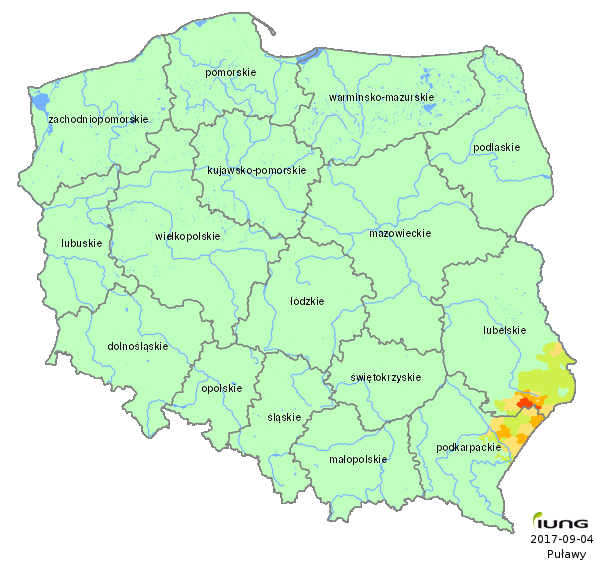
In the eleventh reporting period, i.e. from July 1st to August 31st 2017, IUNG-PIB stated agricultural drought conditions in Poland.
In the current sixty-day reporting period drought occurs in three plant groups:
- legumes
- fruit shrubs
- potatoes
Risk of agricultural drought occurs in three groups and species of plants localised on soils of Category I of drought susceptibility. Category I consists of very light soils, granulometric groups as follows: loose sand, loose dusty sand, slightly loamy sand, and slightly loamy dusty sand.
Drought was reported in legumes localised in lubelskie and podkarpackie voivodships, in 57 local districts in Poland (2.3% of all local districts in Poland), in the area of 0.26% of total arable land. Table 1 presents detailed data on drought occurrence for local districts and the area of arable land in lubelskie and podkarpackie voivodships.
Table 1.
| No. | Voivodship | Number of local districts | Number of local districts at risk | Share of local districts at risk [%] | Share of the area at risk [%] |
|---|---|---|---|---|---|
| 1. | lubelskie | 213 | 36 | 16.90 | 1.71 |
| 2. | podkarpackie | 160 | 21 | 13.12 | 2.19 |
Drought occurred also in fruit shrubs localised in lubelskie and podkarpackie voivodships, in 37 local districts (1.49% of all local districts in Poland), in the area of 0.14% of total arable land. Table 2 presents detailed data on drought occurrence for local districts and the area of arable land in particular voivodships.
Table 2.
| No. | Voivodship | Number of local districts | Number of local districts at risk | Share of local districts at risk [%] | Share of the area at risk [%] |
|---|---|---|---|---|---|
| 1. | lubelskie | 213 | 23 | 10.80 | 0.74 |
| 2. | podkarpackie | 160 | 14 | 8.75 | 1.46 |
Drought was also reported in potatoes in lubelskie voivodship, in 9 local districts (0.36% of all local districts in Poland), in the area of 0.01% of total arable land. Table 3 presents detailed data on drought occurrence for local districts and the area of arable land in lubelskie voivodship.
Table 3.
| No. | Voivodship | Number of local districts | Number of local districts at risk | Share of local districts at risk [%] | Share of the area at risk [%] |
|---|---|---|---|---|---|
| 1. | lubelskie | 213 | 9 | 4.23 | 0.14 |
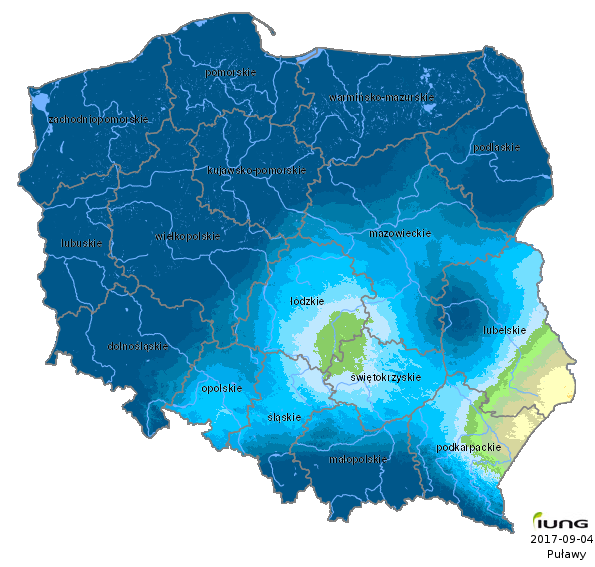
The average value of Climatic Water Balance in Poland in the current sixty-day reporting period has decreased in relation to the previous one by 18 mm and reached -35 mm.
The lowest CWB values are still recorded in the south-eastern part of Poland: in Roztocze, the Wołyńska Upland and the Tarnogrodzki Plateau, ranging from -150 to -169 mm.
In July the lowest temperatures were recorded in the northern and north-eastern Poland, ranging from below 15 to 17°C, which was 0.5°C below the multiannual norm. Much higher temperatures were recorded in the southern and south-western parts of the country, ranging from 18 to more than 19°C and exceeding the multiannual norm by 1°C. In the rest of the country the temperatures in July were similar to the multiannual norm (17-18°C).
The first decade of August was warm. As in the previous month, so in August the first decade was the coldest in the north, with temperatures ranging from below 19 to 20°C. Much higher temperatures were recorded in central Poland, from 19 to more than 22°C, and the highest in the south, ranging from 22 to more than 23°C.
The second decade of August was the coldest in the Pomeranian Lake District (below 18°C). In the vast majority of the country temperatures ranged between 18-20°C. The highest temperatures were recorded in the Sandomierska Basin and in the south-eastern part of Poland, exceeding 20°C.
The third decade of August was cold in the north-eastern regions of Poland, with temperatures ranging from 15 to 15.5°C. The temperature rose towards the south-west, reaching 17-18.5°C in the west.
In July the most intense precipitation occurred in the northern and north-western parts of the country and in the Silesian Lowland, where it ranged from 130 to more than 180 mm (170-260% of the multiannual norm). In the Małopolska Upland and the Sandomierska Basin precipitation was scarce and ranged from 30 to 50 mm. It constituted 60-90% of the multiannual norm. In the majority of the country precipitation ranged from 70 to 130 mm and exceeded the multiannual norm even by 100-170%. Only in the south-eastern part of Poland it ranged between 50-70 mm, which constituted 70-100% of the norm.
In the first decade of August precipitation was less intense. However, in the region of Greater Poland and Lubusz Land it was still quite abundant, ranging from 30 to 80 mm. Very low precipitation was recorded in the north-western part of the country, and in the Silesian, Małopolska and Lubelska Uplands, where it did not exceed 10 mm, or at times even 5 mm. In the rest of the country precipitation ranged from 10 to 30 mm.
In the second decade of August the lowest precipitation (below 10 mm) was recorded in the south-eastern regions of Poland and in the area of Koło, Kłodawa and Włocławek. The highest precipitation values were recorded in the Carpathian Foothills (above 100 mm), and slightly lower values (50-100 mm) in the Pomeranian Lake District, the Sudeten Plateau, Podlasie, and in the upper Vistula river basin. In the rest of the country precipitation ranged from 10 to 50 mm. In the third decade of the month, abundant precipitation occurred only in the northern regions of the country and ranged from 40 to 100 mm. In the rest of Poland it was scarce, from 10 to 40 mm or even below 5 mm.
In the last monitored decade precipitation was low (with the exception of the northern part of Poland), with high temperatures and insolation, which caused a slight increase in water deficiency. It created agricultural drought conditions in legumes, fruit shrubs and potatoes cultivated in the area of south-eastern Poland.
Report prepared by:
Dr hab. Andrzej Doroszewski, prof. nadzw.
Dr hab. Rafał Pudełko
Dr Katarzyna Żyłowska
Mgr Piotr Koza
Mgr Elżbieta Wróblewska
Reports
- Report 14 (1.VIII - 30.IX)
- Report 13 (21.VII - 20.IX)
- Report 12 (11.VII - 10.IX)
- Report 11 (1.VII - 31.VIII) +
- Report 10 (21.VI - 20.VIII)
- Report 09 (11.VI - 10.VIII)
- Report 08 (1.VI - 31.VII)
- Report 07 (21.V - 20.VII)
- Report 06 (11.V - 10.VII) +
- Report 05 (1.V - 30.VI) +
- Report 04 (21.IV - 20.VI)
- Report 03 (11.IV - 10.VI)
- Report 02 (1.IV - 31.V)
- Report 01 (21.III - 20.V)