ARCHIVES (2017)
Do roku 2016 raport oznaczony numerem 1 był tworzony za okres od 1 kwietnia do 31 maja. Od roku 2017 analizy są wykonywane o dekadę wcześniej czyli 1 raport oznacza okres od 21 marca do 20 maja
Communication report regarding the incidences of drought conditions in Poland
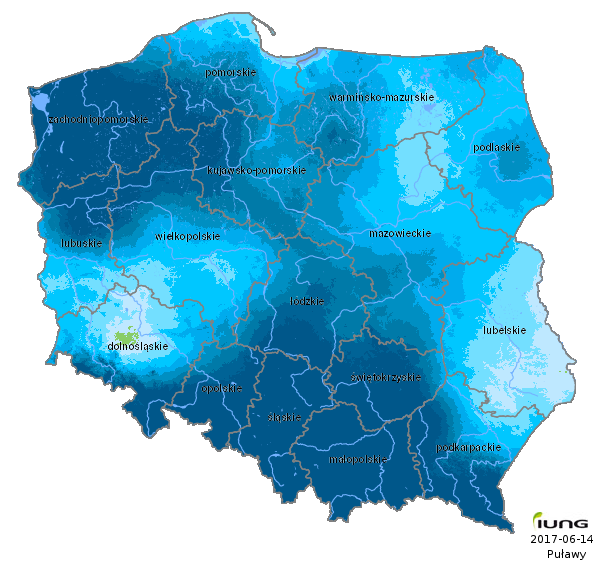
Year: 2017; period: 03 (11.IV - 10.VI)
The Institute of Soil Science and Plant Cultivation – State Research Institute, in accordance with an Act of the Minister of Agriculture and Rural Development has developed the climatic water balance for all 2478 Polish local districts and, on the basis of soil categories, calculated the current risk of agricultural drought for the following crops: winter and spring cereals, rape, turnip rape, potatoes, sugar beet, fruit shrubs and trees, and strawberries.
In the third reporting period, i.e. from April 11th t° June 10th 2017, IUNG-PIB stated n° agricultural drought conditions in Poland. The Climatic Water Balance values, which are the basis for assessing the risk of agricultural drought, are negative for the majority of areas.
In the whole country, the recorded Climatic Water Balance values were higher than -129 mm, the average for the country being -86 mm, which is 31 mm lower than in the previous reporting period. Despite the considerable reduction in the measured Climatic Water Balance values, it can be stated that presently there is no risk of agricultural drought.
The lowest Climatic Water Balance values, from -120 to -129 mm were recorded in the area of Lower Silesian Wilderness. Other areas with low Climatic Water Balance values were the Łużyckie Hights and the eastern regions of Lubelskie: Dubienka Depression, Działy Grabowieckie and Grzęda Horodelska, with values between -110 and -119 mm. Relatively considerable water shortage, from -100 to 109 mm was recorded in the northern regions of the Silesian Lowland, in the Lubelskie Lake District and Kolneńska Upland.
April was cold this year, the air temperature ranged from 5 to more than 8ºC. The highest temperatures were recorded in the Silesian Lowland and Sandomierska Basin (above 8ºC). In these areas the temperatures remained within the norm. The further to the north-east the lower was the temperature. The lowest were recorded in the north of the country and ranged from 5 to 6ºC. In Małopolska Lowland, in the eastern regions of Pomeranian Lake District and in the western part of Mazurskie Lake District the temperature was 0.5-1.0ºC lower than the multiannual norm.
In the first decade of May thermal conditions varied greatly. It was the warmest in the east, where temperatures exceeded 10ºC, and the coldest in the north, where temperatures ranged from 6 to 7ºC. In the second decade of the month the lowest temperatures were recorded in the east and ranged from below 13°C to 14ºC. The highest temperatures, ranging from 15 to more than 16.5ºC, were recorded in the west of the country. The third decade of May was much warmer in the vast majority of areas, with temperatures ranging from 16 to more than 17.5ºC. Only in the north it was colder, with temperatures from 14.5 to more than 16ºC.
In the first decade of June thermal conditions varied as well. It was cold in the vast area in the north-eastern Poland, where temperatures ranged from below 14 to 15ºC. The highest temperatures, on the other hand, were recorded in the western and eastern regions, as well as in the south-west of the country, and ranged from 16 to more than 18ºC. In the rest of the country the air temperature ranged from 15 to 16ºC.
In April precipitation in Poland was scarce. Low precipitation, below 30 mm was recorded in the Lubuskie Land and constituted 70-90% of the multiannual norm. In the vast majority of the country precipitation ranged from 30 to 50 mm, which was 100-130% of the norm. Very high precipitation values, from 50 to 140 mm, were recorded in the Sudetian Foreland, the Silesian, Podlaska and Masovian Lowlands, the Silesian, Krakow-Częstochowa and Małopolska Uplands, and in the eastern part of the Mazurskie Lake District, where they constituted from 130 to 230% of the multiannual norm. Particularly intense precipitation occurred in Podhale and in the Tatra Mountains, ranging from 140 to 260 mm and constituting 230 to more than 250% of the multiannual norm.
In May precipitation varied across the country. In the first decade of the month intense precipitation occurred in many regions such as Szczecińska Lowland, Pomeranian Lake District, Masovia, Małopolska Upland, and Subcarpathia, where it ranged from 20 to 50 mm. In the rest of the country precipitation ranged from 5 to 20 mm. In the second decade of May precipitation was considerably less intense. The highest values, from 10 to 30 mm, were recorded in the western, north-western and south-eastern regions of the country. In the rest of the country precipitation was less intense and ranged from 5 to 10 mm, or even less than 5 mm. In the third decade, however, the intensity of precipitation increased in the majority of areas and ranged from 10 to 20 mm. In the north-western and south-eastern regions of Poland precipitation was even more intense, from 20 to 50 mm. Only in the north-eastern regions of the country it did not exceed 5 mm.
In the first decade of June precipitation also significantly varied. In the eastern regions of the country it was scarce, from below 5 to 10 mm. More intense precipitation occurred in the western and central Poland, ranging from 10 to 50 or even more than 60 mm.
The recent weather conditions caused a decrease of Climate Water Balance values, which means that the water stress is growing for the field crops. However, water reserves mitigate the water stress intensity, preventing significant yield reduction. The current Climatic Water Balance values do not exceed the critical values, which means there is no risk of agricultural drought in Poland at the moment.
Report prepared by:
Dr hab. Andrzej Doroszewski, prof. nadzw.
Dr hab. Rafał Pudełko
Dr Katarzyna Żyłowska
Mgr Piotr Koza
Mgr Elżbieta Wróblewska
Reports
- Report 14 (1.VIII - 30.IX)
- Report 13 (21.VII - 20.IX)
- Report 12 (11.VII - 10.IX)
- Report 11 (1.VII - 31.VIII) +
- Report 10 (21.VI - 20.VIII)
- Report 09 (11.VI - 10.VIII)
- Report 08 (1.VI - 31.VII)
- Report 07 (21.V - 20.VII)
- Report 06 (11.V - 10.VII) +
- Report 05 (1.V - 30.VI) +
- Report 04 (21.IV - 20.VI)
- Report 03 (11.IV - 10.VI)
- Report 02 (1.IV - 31.V)
- Report 01 (21.III - 20.V)