ARCHIVES (2014)
Do roku 2016 raport oznaczony numerem 1 był tworzony za okres od 1 kwietnia do 31 maja. Od roku 2017 analizy są wykonywane o dekadę wcześniej czyli 1 raport oznacza okres od 21 marca do 20 maja
Communication report regarding the incidences of drought conditions in Poland
Year: 2014; period: 09 (21.VI - 20.VIII)
The Institute of Soil Science and Plant Cultivation - State Research Institute in accordance with an Act from the Minister of Agriculture and Rural Development has developed the climatic water balance for all Polish municipalities (3,064 municipalities), and based on the soils categories have identified in those municipalities the current agricultural drought risk for the following crops: winter and spring cereals, corn for grain and silage, potatoes, sugar beets, hops, tobacco, field vegetables, shrubs and fruit trees, strawberries and legumes.
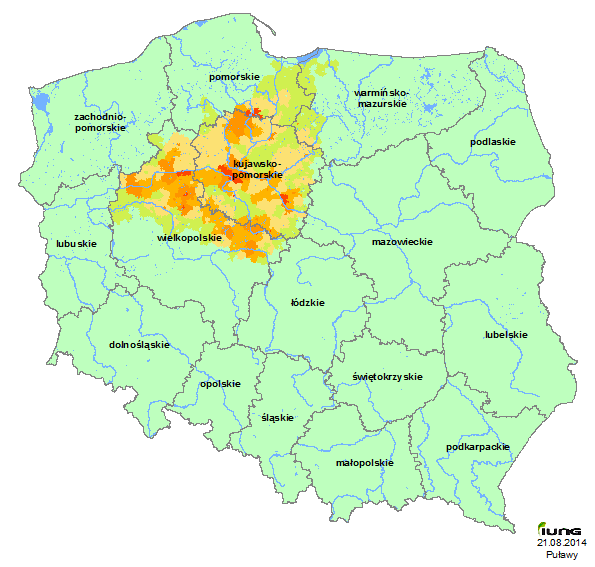
In the ninth reporting period, i.e. from June 21 to August 20, 2014, IUNG-PIB state a risk of agricultural drought in Poland.
Drought occurs for:
• legumes,
• potato,
• fruit shrubs,
grown on soils of category I (very light).
The largest area of drought risk is considered for legumes cultivation, and covers 2.5% of the arable Polish land, gathered in 335 local districts (10.9% of country local districts). Drought for legumes occurs in four voivodeship:
|
Voivodeship |
Number of local districts at risk |
The share of local district at draught risk [%] |
The share of area at draught risk [%] |
|
kujawsko-pomorskie |
164 |
91.6 |
18.6 |
|
wielkopolskie |
116 |
36.7 |
10.2 |
|
pomorskie |
40 |
28.6 |
2.2 |
|
warmińsko-mazurskie |
15 |
10.1 |
0.5 |
The threat of drought for potato is at 0.2% Polish arable land concentrated in 18 local districts (0.6% of the local district of the country). Drought for potato occurs in four voivodeships:
|
Voivodeship |
Number of local districts at risk |
The share of local district at draught risk [%] |
The share of area at draught risk [%] |
|
Kujawsko-pomorskie |
18 |
10.1 |
0.3 |
The threat of drought for fruit shrubs is 0.02% Polish arable land concentrated in 18 local districts (0.6% of the country’s local districts). Drought of shrubs found in four voivodeships:
|
Voivodeship |
Number of local districts at risk |
The share of local district at draught risk [%] |
The share of area at draught risk [%] |
|
Kujawsko-pomorskie |
18 |
10.1 |
0.3 |
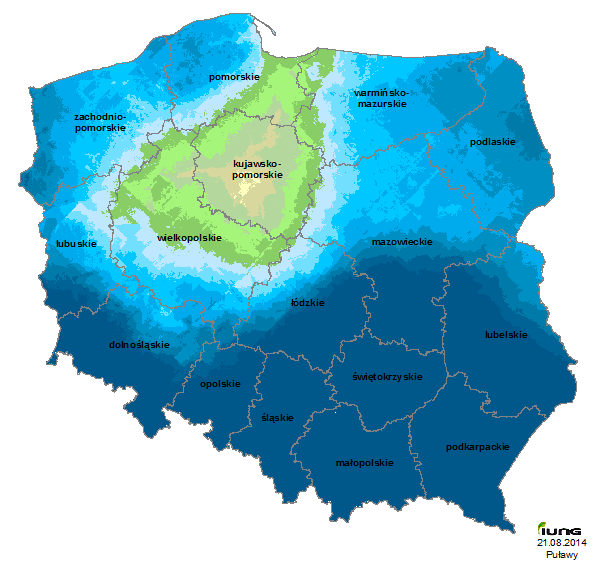
The values of climatic water balance (CWB), which are the basis to assess the risk of drought in most Polish areas, are negative.
The lowest values of CWB, occurred in a similar area as in previous reporting periods. In the current reporting period, these values were approx. 20 mm higher than the previous ones. In the Central Noteć Valley and in the Toruń Basin, these values ranged from -160 to -169 mm. The continued low CWB values were noted in Chełmiński Lakeland, Świecka Uplands, in the Iława Lake District, in areas of Chodzieskiego and Gniezno Lake District and on the Inowrocławska Plain, from -130 to -159 mm. Such low values of CWB in the current period under consideration sixty days period meant that in this area there is a risk of drought for legumes, potato and fruit shrubs.
The highest values of CWB, similar to previous ten days period, amounting to approximately -50 mm were recorded over a large part of the country in the south-eastern, south-western, southern, western and north-eastern Poland.
CWB values throughout the Poland in comparison to the previous reporting period increased substantially, even up in the south parts of the country up to 100 mm in the mountain and the foothills.
Potential evapotranspiration in the current sixty days period in the country, compared to the previous reporting period, has been significantly reduced, while the precipitation was relatively large. This pattern of weather meant that the CWB for the country have increased by an average of 27 mm.
In June, the coldest was in the north-eastern Poland, and ranged from 14 to 15°C, in the mountains it was even colder, below 13°C. In the most territory temperature was between 15 to 17°C. In terms of the temperature in compare to long term average this month should be regarded as normal, only the north-east air temperature was lower than norm by about 1°C.
This year's July was very warm. The warmest was t in the Wielkopolska Lowland, where the air temperature in the area even exceeds 22°C. The rest of the Poland was also very warm, in central Poland temperature was over 21°C, and in the north and east of the country recorded a temperature of 19 to 21°C. Only in the mountains was a bit cooler around. 15-18°C. In terms of temperature, July this year relatively to the long-term average, should be regarded as extremely warm, in Wielkopolska and Kujawy air temperature was higher by more than 4°C, the rest of the country was also much warmer than the long term average, from 2 to 4°C.
The first ten days period of August was another very warm period of the current sixty days period. To the west of the Wisła river, air temperature ranged from 20.5 to 21.5°C, only the north and south of the area was a bit cooler with temperatures being less than 20.5°C. In contrast, east of the Wisła river was warmer temperature were from 21.5°C to above 22.5°C (warmest was in the eastern part of the country).
In the second ten days of August in the country it was definitely cooler, yet only in the south-eastern part of the Poland, air temperature was 17.5-18.5°C, and in most parts recorded from 15.5-17.5°C.
The precipitation in June was very diverse. In the eastern part of the country precipitation ranged from 60 to over 120 mm, with the largest occurred in the eastern part of Poland. In this area, they accounted for 100 to more than 160% of long-term norm. However, in the western part of the country rainfall was much smaller and ranged from 30 to 40 mm, which accounted for 50-80% of long-term norm.
July was characterized by a great diversity in terms of precipitation. On the northern Polish territory rainfall was relatively small, from 40 to 80 mm, which accounted for 40 to 90% of long-term norm. In contrast, the area of the southern Poland precipitation was much higher, ranging from 80 to 200 mm, accounted for 100-130% of long-term norm. In the mountains the rainfall was even higher and ranged from 200 to 400 mm. The Świętokrzyskie Mountains, in the Sandomierz Basin, the Carpathian Foothills and in the Beskidy rainfall standards have been greatly exceeded, from 150 to 200%.
The first ten days of August was characterized by considerable diversity in terms of precipitation. On the majority of the country rainfall ranged from 10 to 50 mm and wherein approx. for half of this area rainfall was ranging from 25 to 50 mm. The highest values of rainfall was recorded in the Mazowsze Lowland, in the south-western regions of the Mazury Lake District and the Karpaty Foothills and Western Beskidy Mountains, rainfall in these areas ranged from 50 to 100 mm. Throughout the country there have been relatively small areas with very low rainfall amounting to less than 10 mm. The areas include: Suwalskie and Starogardzkie Lake District, Bory Tucholskie, Śląska and Lublin Upland, Foothills: Rzeszów, Dynowskie and Przemyskie.
In the second ten days of August in the north-western and south-eastern Poland rainfall were very heavy, ranged from 25 to 100 mm. Less rainfall was recorded in a broad belt from the southwest to the northeast, in the area reported rainfall ranged from 10 to 25 mm, with the exception of Wielkopolska, where they were less than 10 mm.
Reports
- Report 13 (1.VIII - 30.IX)
- Report 12 (21.VII - 20.IX)
- Report 11 (11.VII - 10.IX) +
- Report 10 (1.VII - 31.VIII) +
- Report 09 (21.VI - 20.VIII) +
- Report 08 (11.VI - 10.VIII)
- Report 07 (1.VI - 31.VII)
- Report 06 (21.V - 20.VII)
- Report 05 (11.V - 10.VII)
- Report 04 (1.V - 30.VI)
- Report 03 (21.IV - 20.VI)
- Report 02 (11.IV - 10.VI)
- Report 01 (1.IV - 31.V)