ARCHIVES (2014)
Do roku 2016 raport oznaczony numerem 1 był tworzony za okres od 1 kwietnia do 31 maja. Od roku 2017 analizy są wykonywane o dekadę wcześniej czyli 1 raport oznacza okres od 21 marca do 20 maja
Communication report regarding the incidences of drought conditions in Poland
Year: 2014; period: 07 (1.VI - 31.VII)
The Institute of Soil Science and Plant Cultivation - State Research Institute in accordance with an Act from the Minister of Agriculture and Rural Development has developed the climatic water balance for all Polish municipalities (3,064 municipalities), and based on the soils categories have identified in those municipalities the current agricultural drought risk for the following crops: winter and spring cereals, corn for grain and silage, potatoes, sugar beets, hops, tobacco, field vegetables, shrubs and fruit trees, strawberries and legumes.
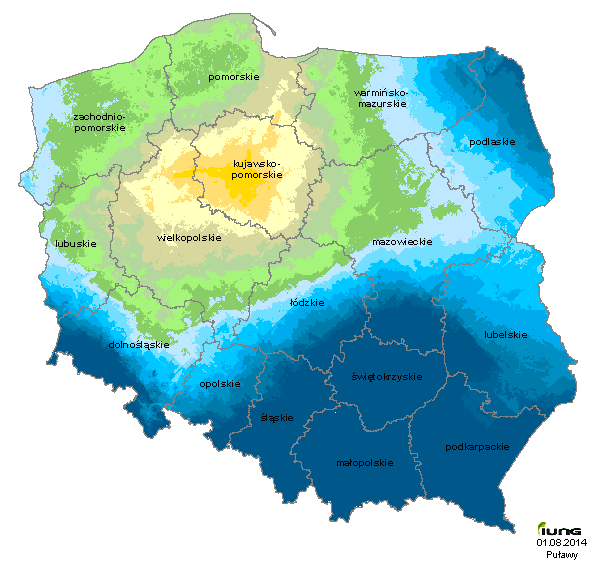
In the seventh reporting period, i.e. from June 1 to July 31, 2014, IUNG-PIB does not state a risk of agricultural drought in Poland. The values of climatic water balance (CWB), which are the basis to assess the risk of drought in most areas, are negative, but these values for the above-mentioned crops are much higher than the critical value.
Low values of CWB in the current reporting period occurred in the north-western and northern Poland. In this part of the country they were lower than 120 mm. The lowest values of CWB, occurred at a similar area as ten days ago (Kujawy). However, in the current reporting period these values were approximately 20 mm lower than the previous one. In the Central Valley of Noteć and the Toruń Basin these values ranged from -170 to -199 mm. Still low CWB values were recorded in Chełmiński Lakeland, Świecka Plateau, in the Ilawa lake districts, in areas Chodzieskie and Gniezno Lake District and on the Inowrocławska Plains, from -160 to -169 mm.
The highest values of CWB, amounting to approximately -50 mm were recorded over a large part of the country in the south-east, south-western, southern, western and north-eastern Poland.
Changes in the CWB value on Polish territory to the previous reporting period were significantly differentiated. There have been areas with a significant reduction of CWB, in the Wielkopolska up to 60 mm and territories with a large increase in the value of CWB up to 50 mm in mountainous areas and foothill areas. The national average value of CWB decreased by 9 mm.
In the first ten days of June highest air temperature occurred in western Poland, reaching in Ziemia Lubuska and the Śląska Upland highest temperature ranging from 17.5 to 18.5°C. In the large area of Poland, temperature ranged from 16.5 to 17.5°C. In the eastern part of north country, the temperature was lower and ranged from 15.5 to 16.5°C. The second ten days of June was relatively cold. The warmest areas of the country was the western and south-western parts of Poland with temperatures ranging from 16 to 18°C and the coldest areas of the north-eastern parts of Poland with temperature from 13 to 16°C. Definitely the third ten days of June was the coldest. In north-eastern parts of Poland air temperature was even below 13.5°C. In most parts of Poland temperature ranged from 13.5 to 15°C, only in the north of Podkarpacie was a little warmer and ranged from 15.5 to 16°C.
Taking into account three periods of June, we can conclude that it the coldest was in the north-eastern Poland, and ranged from 14 do15°C, in the mountains it was even colder, below 13°C. In the most territory temperature was between 15 to 17°C. In terms of the temperature in compare to long term average this month should be regarded as normal, only the north-east air temperature was lower than norm by about 1°C.
The first ten days of July was relatively warm. The warmest area was in the northern part of the country, from 20 to 21.5°C, but without the Podlasie Lowland and eastern parts of the Mazury Lake District, where the air temperature in these areas ranged from 19 to 20°C. In the south of the country the temperature was lower, less than 19°C, and definitely the coldest was in Podhale and the Bieszczady Mountains amounting around 17.5°C. The second ten days of July was a large area of the country very warm. In the south-west parts of country average air temperature was above 21°C and in some places in this area, even exceed 22°C. For the rest of the Poland temperature ranged from 18.5 to 21°C, only in the northern reaches of the country was a bit cooler with temperatures below 18.5°C. The third ten days of July was also very warm, warmer even in the second ten days of this month. In the most territory of the country recorded a temperatures from 20.5 to 22.5°C, only on the coast and in the mountains it was a bit cooler around 20°C. The hottest was in Warmia around 23°C.
Precipitation in the first ten days of June was very varied, from small, few millimetre in Ziemia Lubuska, Śląska Upland and the Karpaty Foothills and western Beskidy, to 5 to 20 mm occurring over a large area of the country. In the east part of the north parts of the country, precipitation was higher, ranged from 20 to 40 mm and at the edge of the country rainfall amounted to 50 mm. In the second ten days of June the highest rainfall was recorded in the northern part of the country ranging from 30 to 60 mm, the further south the rainfall was lower and in the Polish Uplands were even less than 5 mm. In southern Poland precipitation was little larger, from 5 to 20 mm. The third ten days period of June was characterised with large variation in terms of precipitation. The relatively low values of rainfall were recorded in Wielkopolskie Lakeland of around 10 mm. In large areas of the north-western Poland rainfall ranged from 10 to 25 mm. In contrast, high precipitation were recorded in the south-eastern part of the country ranging from 50 to 100 mm, and in some places of the area amounted to more than 150 mm.
Taking into account the whole month of June, we can conclude that in the eastern part of the country precipitation ranged from 60 to over 120 mm, with the largest occurred in the eastern part of Poland. In this area, they accounted for 100 to more than 160% of long-term norm. However, in the western part of the country rainfall was much smaller and ranged from 30 to 40 mm, which accounted for 50-80% of long-term norm.
The first decade of July was characterized by great diversity in terms of precipitation. Very large precipitation occurred in the Izerskie Foothills, in the Western Carpathians, Śląskio-Krakowska and Lublin Upland, as well as in Oleśnicka Plain, in these regions recorded rainfall ranged from 50 to over 100 mm. On the large Polish area precipitation ranged from 10 to 50 mm, while the smallest rainfall was recorded in north-eastern part of the country, amounting to less than 10 mm.
In the second ten days of July precipitation in the country were very different. In areas where it was warmest (in the south-western part of the Poland) rainfall was very small, less than 10 mm. In contrast, in areas where the air temperature was slightly lower - precipitation were higher, ranging from 10 to 50 mm, and in the Gory Świetokrzyskie, in the Sandomierz Basin, CKarpaty Foothills and in the Beskidy Mountains were much higher, ranged from 50 to 125 mm.
In the third ten days of July the northern part of the country was characterized by low rainfall, amounting from 10 to 25 mm, while the southern part was characterised with heavy rain ranging from 25 to 150 mm, while in the mountains, these values were even exceed 200 mm.
Reports
- Report 13 (1.VIII - 30.IX)
- Report 12 (21.VII - 20.IX)
- Report 11 (11.VII - 10.IX) +
- Report 10 (1.VII - 31.VIII) +
- Report 09 (21.VI - 20.VIII) +
- Report 08 (11.VI - 10.VIII)
- Report 07 (1.VI - 31.VII)
- Report 06 (21.V - 20.VII)
- Report 05 (11.V - 10.VII)
- Report 04 (1.V - 30.VI)
- Report 03 (21.IV - 20.VI)
- Report 02 (11.IV - 10.VI)
- Report 01 (1.IV - 31.V)