ARCHIVES (2014)
Do roku 2016 raport oznaczony numerem 1 był tworzony za okres od 1 kwietnia do 31 maja. Od roku 2017 analizy są wykonywane o dekadę wcześniej czyli 1 raport oznacza okres od 21 marca do 20 maja
Communication report regarding the incidences of drought conditions in Poland
Year: 2014; period: 02 (11.IV - 10.VI)
The Institute of Soil Science and Plant Cultivation - State Research Institute in accordance with an Act from the Minister of Agriculture and Rural Development has developed the climatic water balance for all Polish municipalities (3,064 municipalities), and based on the soils categories have identified in those municipalities the current agricultural drought risk for the following crops: winter and spring cereals, oilseed rape and turnip rape, sugar beet, shrubs and fruit trees and strawberries.
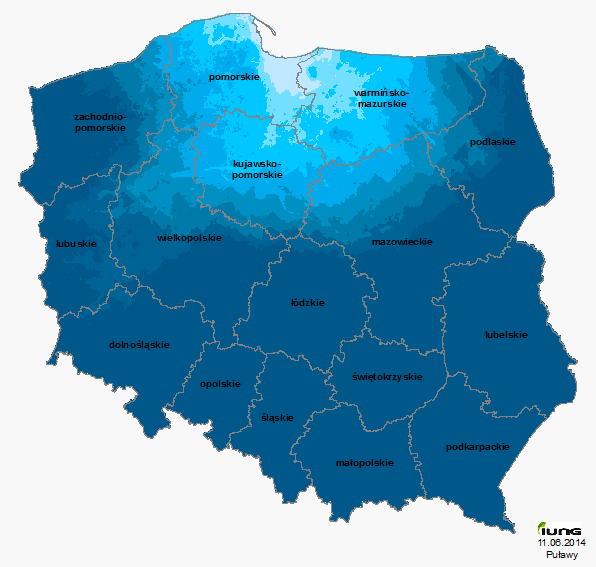
In the second reporting period, i.e. from April 11 to June 10, 2014, IUNG-PIB does not state a risk of agricultural drought in Poland. The values of climatic water balance (CWB), which are the basis to assess the risk of drought in most areas, are negative, but these values for the above-mentioned crops are much higher than the critical value.
The lowest CWB values, as in the first reporting period, occurred in Żuławy, except that these values were 20 mm lower than in the previous period, currently listed values ranged from -100 to -119 mm. The relatively low CWB value also occurred in the area of lake districts: Mazury (in the western part) and Pomorskie and Wielkopolskie (in the eastern parts) from -90 to -109 mm.
In contrast, across the country average CWB value in the current reporting period was lower than the previous period by 16 mm.
The highest values CWB (like ten days ago), were recorded in Karpaty Foothills, Western Beskidy and in the Lublin Upland, ranged from 80 to 130 mm.
April this year was very warm, the highest air temperature occurred in western Poland, reaching more than 11°C in Ziemia Lubuska and Ślaska Upland. In the large area of the country temperature was from 9 to 11°C. In the north of the country (eastern part), the temperature was much lower and ranged from 4 to 6 ° C. In the most parts of Poland air temperature was higher than the long-term average (1971 to 2000) by 2-3°C, while in the western part of the Pradolina Toruńsko-Eberswaldzka was higher by more than 3°C. Only at Slowinski Coastland air temperature in April was slightly higher than the long-term average, by 1-2°C.
A very similar distribution of air temperature was recorded in the first ten days of June. In Ziemia Lubuska and the Śląska Upland the highest temperature from 17.5 to 18.5°C were recorded. In large area of Poland, temperature ranged from 16.5 to 17.5°C, and in the north of the country (eastern part), was lower and ranged from 15.5 to 16.5°C.
May this year in terms of heat was relatively diverse. The highest air temperature occurred in the eastern and south-eastern part of the Poland, reaching more than 14°C. In most parts of the country a temperature of 13 to 14°C was recorded. The coldest areas were in the north of the country and in the mountains, in these regions the air temperature was 11-12°C.
In April, a high diversity of precipitation was found. Very low rainfall, less than 20 mm occurred in the eastern part Suwałki Lake District, they accounted for less than 50% of normal long-term value. Low rainfall ranging 20-30 mm occurred also in Mazury Lake District and Podlaska Lowland and was 50-70% of norm for these areas. Precipitation of similar size occurred in the Konin Valley and the Rychwalska Plains, which was in these areas 100% of norm. In contrast, it should be noted the relatively high precipitation occurring in the lake districts: Poznan, Drawskie, Szczecinek, Wałeckie, they were in these regions from 50 to 70 mm, acting from 130 to 180% of long-term norm. The highest precipitation was recorded in the Carpathians, more than 100 mm.
May this year in terms of precipitation was varied. The lowest precipitation occurred in the north and especially in the north-eastern part of the country from 20 to 100 mm, the further south, the rainfall values were higher. The highest precipitation was recorded in the Sudety, in the Lublin Upland and in the eastern and western Beskidy, in Podhale and Tatry, from 100 to over 300 mm. In some places they were listed as precipitation record.
Precipitation in the first ten days of June were very varied, from small few millimeter in Ziemia Lubuska, Śląska Upland and the Karpaty Foothills and Western Beskidy to 5-20 mm occurring over a large area of the country. In the north of the country( eastern part), precipitation was higher, ranged from 20 to 40 mm and at the north edge of the country, rainfall amounting to more than 50 mm was recorded.
Heavy rainfall that occurred across the country and occurs at a time of relatively high temperatures could create a major shock of cereals and oilseed rape. There is a high risk for the development of many fungal diseases in cereals such as leaf septoria, brown leaf spot, leaf rust, in the case of rape - stem rot. Currently, the prevailing weather conditions are also favour for the development of fungal diseases in apple trees (apple scab).
Reports
- Report 13 (1.VIII - 30.IX)
- Report 12 (21.VII - 20.IX)
- Report 11 (11.VII - 10.IX) +
- Report 10 (1.VII - 31.VIII) +
- Report 09 (21.VI - 20.VIII) +
- Report 08 (11.VI - 10.VIII)
- Report 07 (1.VI - 31.VII)
- Report 06 (21.V - 20.VII)
- Report 05 (11.V - 10.VII)
- Report 04 (1.V - 30.VI)
- Report 03 (21.IV - 20.VI)
- Report 02 (11.IV - 10.VI)
- Report 01 (1.IV - 31.V)