ARCHIVES (2012)
Do roku 2016 raport oznaczony numerem 1 był tworzony za okres od 1 kwietnia do 31 maja. Od roku 2017 analizy są wykonywane o dekadę wcześniej czyli 1 raport oznacza okres od 21 marca do 20 maja
Communication report regarding the incidences of drought conditions in Poland
Year: 2012; period: 03 (21.IV - 20.VI)
The Institute of Soil Science and Plant Cultivation - State Research Institute Puławy has developed the climatic water balance for all 3,064 local districts of Poland. The assessment is based on the soil categories identified in the local districts according to their current state of agricultural drought risk for the following crops: winter and spring cereals, grain maize and silage, rape and turnip rape, potato, sugar beet, hops, tobacco, vegetables, shrubs and fruit trees, strawberries and legumes within the period of 21 April till 20 June 2012.
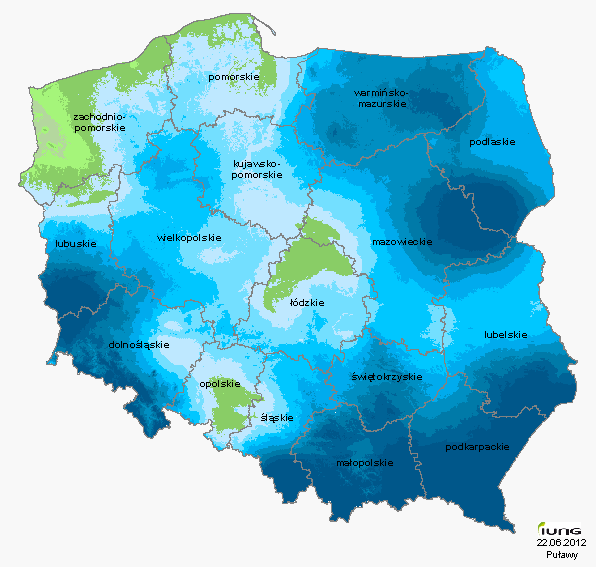
IUNG-PIB states that during the period from 21 April to 20 June 2012, there was no agricultural drought occurrence in Poland. The value of climatic water balance (CWB), on the basis of which the drought risk assessment is calculated were negative; however, these values are for those crops that are slightly higher than the critical value.
The lowest values of CWB from 140 to -149 mm occur in Pobrzeże Szczecińskie, slightly higher values were reported for other coastal areas in the southern part of Mazowsze and the Śląska Upland (from -120 mm to -139 mm). Within the country there were no positive values of CWB.
April of this year was very warm. The highest temperature occurred in central and southern Poland; in the rest of the country the air temperature was also high. Only in the north of the country the temperature was slightly lower. In most parts of the country the air temperature was higher by 1-2 °C than the long-term average value.
In April, there was a very low rainfall in the Wielkopolska region (less than 20 mm), in the western parts of country and in Sandomierz Basin (20-30mm) In contrast, precipitations in the North East parts of country were high, and ranged between 70 and 80 mm (approximately 150-180% of the norm).
In May, the highest air temperatures were recorded in the Śląskie Lowlands and in the south parts of the Wielkopolska Lowlands (15-16°C), and the lowest were on the Gdańsk Coastland (11.5-13°C). The air temperature in Wielkopolska was higher than the long-term norm (1971-2000) by 2-2.5°C, in the main area of country it was higher by 1-2°C, and only in the vicinity of Bialystok it was close to the norm.
In May, the lowest rainfall occurred on the coast (10-20 mm), and a slightly higher value was in a broad belt, west of the Wisła River (20-30 mm).Those areas accounted for 30-60% of the long-term norm. The highest rainfall (100 mm) occurred in the Carpathian region with slightly lower recordings in Warmia, Mazury and western areas of Poland (from 40 to 100 mm).
In first twenty days of June, the lowest rainfall was in the north-western part of Poland (10-20 mm) and the highest was in Wielkopolska, Kujawy, Dolny Śląsk, and southern Podlasie (50-100 mm).
Also in first twenty days of June, the lowest temperatures were still recorded in the north (15.5°C) and highest in the southern parts of Poland.
A low temperature, from 11.9 to 13.5°C was recorded in the first ten days of June in the north, and the highest in the southern Poland (15-16°C.).
In considering the entire sixty day period we state that the lowest precipitation occurred in north-western part of the Polish regions, from 45 to 90 mm, but also the potential evapotranspiration in these areas was the lowest in the country and amounted to 170-200 mm.
However, in Wielkopolska, Śląsk, Kujawy and the southern areas of Mazowsze, these regions recorded the highest evapotranspiration, of 230-250 mm, but the rainfall was slightly higher than in the north of the country and amounted to 100-130 mm. Such moisture conditions in both Polish regions meant that a risk of drought in these areas did not occur and did not cause yield losses of crops and orchards by 20% for the local districts, the average long-term yields.
Relative to the previous reporting period, the threat of drought in the country is now smaller. The average value of CWB has increased over the last 10 days by 6 mm. In the southern part of the Poland, the CBW values have increased on average by 16 mm and in this area the risk of drought has decreased. However, in northern Poland, the CWB declined by an average of 10 mm, which meant that in this region the risk of drought has been increasing.
Reports
- Report 13 (1.VIII - 30.IX)
- Report 12 (21.VII - 20.IX)
- Report 11 (11.VII - 10.IX)
- Report 10 (1.VII - 31.VIII)
- Report 09 (21.VI - 20.VIII) +
- Report 08 (11.VI - 10.VIII)
- Report 07 (1.VI - 31.VII)
- Report 06 (21.V - 20.VII)
- Report 05 (11.V - 10.VII)
- Report 04 (1.V - 30.VI)
- Report 03 (21.IV - 20.VI)
- Report 02 (11.IV - 10.VI) +
- Report 01 (1.IV - 31.V) +