ARCHIVES (2012)
Do roku 2016 raport oznaczony numerem 1 był tworzony za okres od 1 kwietnia do 31 maja. Od roku 2017 analizy są wykonywane o dekadę wcześniej czyli 1 raport oznacza okres od 21 marca do 20 maja
Communication report regarding the incidences of drought conditions in Poland
Year: 2012; period: 02 (11.IV - 10.VI)
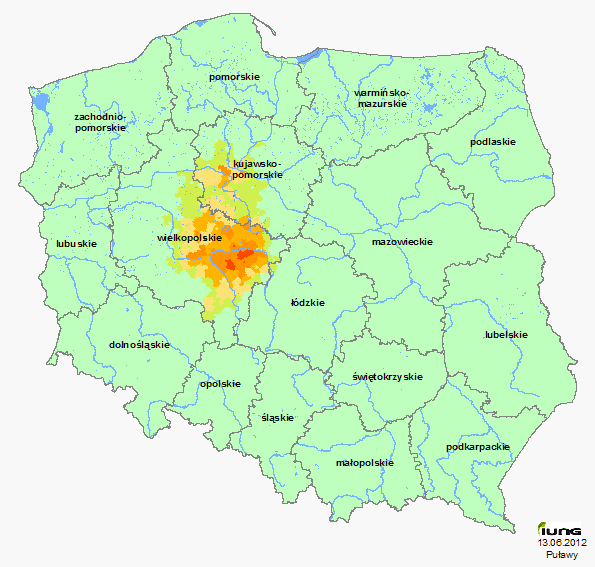
In the second reporting period i.e. from 11 April to 10 June 2012, we confirm a threat of agricultural drought in some regions of Poland. The value of climatic water balance (CWB), on the basis of which the risk assessment of drought is calculated in most parts of areas in Poland was negative.
The threat of drought occurs on only1.6% of arable lands in Poland that is in 176 local districts (5.6% of local districts), concentrated in three Voivoideships:
|
Lp. |
Voivoideship |
Number of local district |
% local districts of the Voivoideship |
% arable land of the Voivoideship |
|
1. |
Wielkopolskie |
127 |
40.2 |
12.5 |
|
2. |
Kujawsko-Pomorskie |
48 |
26.8 |
3.2 |
|
3. |
Łódzkie |
1 |
0.5 |
0.0 |
Drought occurs among fruit shrubs, winter cereals and strawberries grown on type category I soils (very light; group granulometric sand). Soils of this category show a greatest susceptibility to drought.
The highest risk of drought was calculated for fruit shrubs and covers 1.6% of the arable land, potentially used for cultivation of these plants. Smaller concerns were assessed for winter and spring cereal and strawberries, covering only area in the Wielkopolskie Voivoideship. It includes 14 local districts (4.4% local district and 0.1% arable land of the Voivoideship).
Compared to the previous reporting period, the threat of drought on Polish territories was reduced by 38 local districts and the area of threatened arable land by 1.1 percentage points.
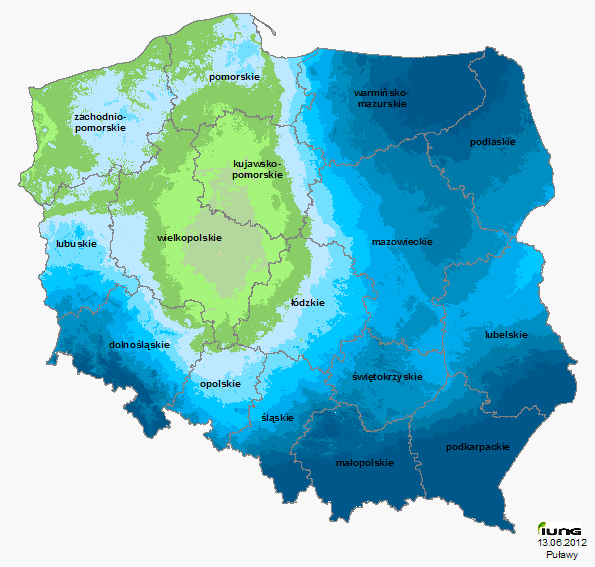
The lowest values of CWB from -140 to -159 mm occur in the south-eastern part of the Wielkopolskie Voivoideship, and in the south-western part of kujawsko-pomorskie Voivoideship, reaching from -140 to -149 mm.
The supreme value of the CWB (positive) was found in the southern parts of the Podkarpackie Voivoideship.
April of this year was very warm. The highest temperature occurred in central and southern Poland, reaching 9-10°C, and in the Sandomierz Basin as well as in the Silesian Uplands over 10°C, in the rest of the country the air temperature was also high, from 7 to 9°C. Only in the north of the country in the western part of Pobrzeze Koszalinskie, the temperature was slightly lower at 6-7°C. In most parts of the country the air the temperature was higher than the average long-term value (from three decades from 1971 to 2000) with 1-2°C, and the Sandomierz Basin and in the Silesian Uplands by more than 2°C.
In April, large differences were found on Polish territories in terms of precipitation. Very low rainfall, less than 20 mm occurred in areas between Poznań, Koło and Kalisz, and they accounted for less than 50% of long-term norm. Low rainfall amounting to 20-30 mm occurred in the western part of the country and in the Sandomierz Basin, which in these areas was 50-80% of the norm. In contrast, precipitations in the North East parts of country were high, and ranged between 70 and 80 mm (approximately 150-180% of the norm).
In May, the highest air temperature were recorded in the Silesian Lowlands and in the south parts of the Wielkopolska Lowlands (15-16°C.), and the lowest were on the Gdańsk Coastland (11.5-13°C).
In May, the lowest rainfall occurred on the coast (10-20 mm), and a slightly higher value was in a broad belt, west of the Wisła River (20-30 mm). The highest rainfall (100 mm) occurred in the Carpathian and western areas of Poland (from 40 to 100 mm).
As in May, also in the first ten days of June the lowest rainfall was in the north-western part of Poland (5-20 mm) and highest in the Carpathian (100 mm).
The low temperature, from 11.9 to 13.5°C was recorded in the first ten days of June in the north, and the highest in the southern Poland (15-16°C.).
Relative to the previous reporting period, the threat of drought in the country is now smaller. The average value of CWB has increased over the last 10 days by 6 mm. In the southern part of the Poland, the CBW values have increased on average by 16 mm and in this area the risk of drought has decreased. However, in northern Poland, the CWB declined by an average of 10 mm, which meant that in this region the risk of drought has been increasing.
In the north of the country, precipitation and any potential evapotranspiration were the lowest, which meant that the value of CWB is relatively high. Nevertheless, in the Wielkoposka region rainfall is only slightly higher than in the north; however, due to higher air temperatures and sunshine - evapotranspiration is high. These conditions meant that in this part of the country it is under the greatest risk of drought.
Reports
- Report 13 (1.VIII - 30.IX)
- Report 12 (21.VII - 20.IX)
- Report 11 (11.VII - 10.IX)
- Report 10 (1.VII - 31.VIII)
- Report 09 (21.VI - 20.VIII) +
- Report 08 (11.VI - 10.VIII)
- Report 07 (1.VI - 31.VII)
- Report 06 (21.V - 20.VII)
- Report 05 (11.V - 10.VII)
- Report 04 (1.V - 30.VI)
- Report 03 (21.IV - 20.VI)
- Report 02 (11.IV - 10.VI) +
- Report 01 (1.IV - 31.V) +